Note: work in progress (lab notes).
My Makita grass trimmer lasts about 15 minutes with two 18V/6Ah batteries (each rated at 108Wh). Makita now offers 12Ah/216Wh LXT packs (released in 2025) but I wanted something even more capable so I bought two 20-cell DIY kits on AliExpress instead.
Using 5Ah cells arranged in 5S4P, each pack would have a nominal capacity of 20Ah or 360Wh which is about 3x the capacity of my current packs, or 50 minutes of runtime (hopefully).
Batteries: 20pcs of 21700 Cells
These kits use 20 pieces of 21700 cells (larger size and higher capacity than 18650 cells) arranged in 5S/4P configuration and I got 50 Shineway 3.7V/5Ah (PDF datasheet) for $160 (including shipping and taxes) which is a total of 925Wh (amazing value).
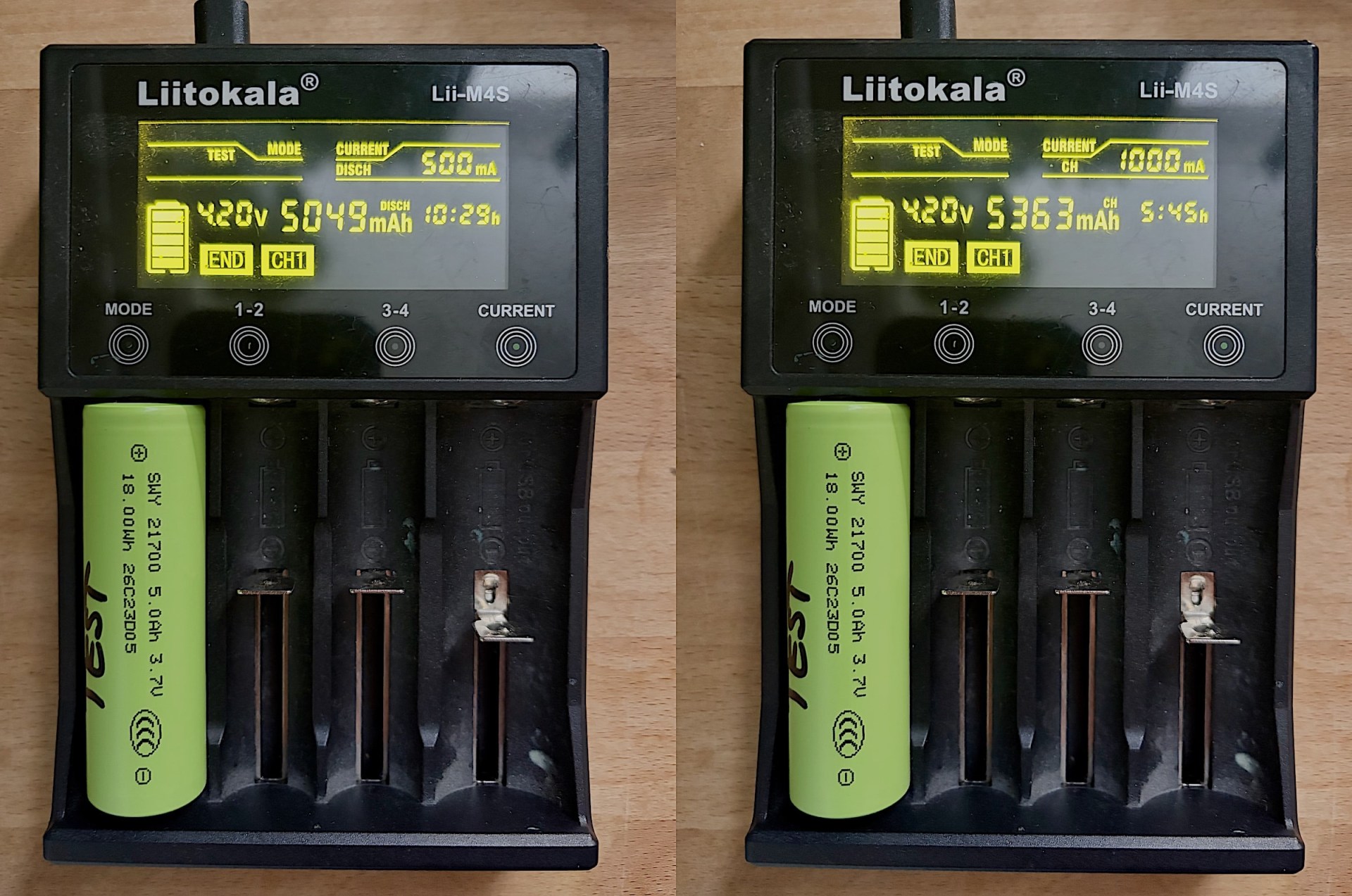
I did some tests and they appear to have the promised capacity at these lower 0.5A and 1A discharge rates:
The manufacturer also publishes a really nice discharge graph (part of the datasheet) at various current rates:
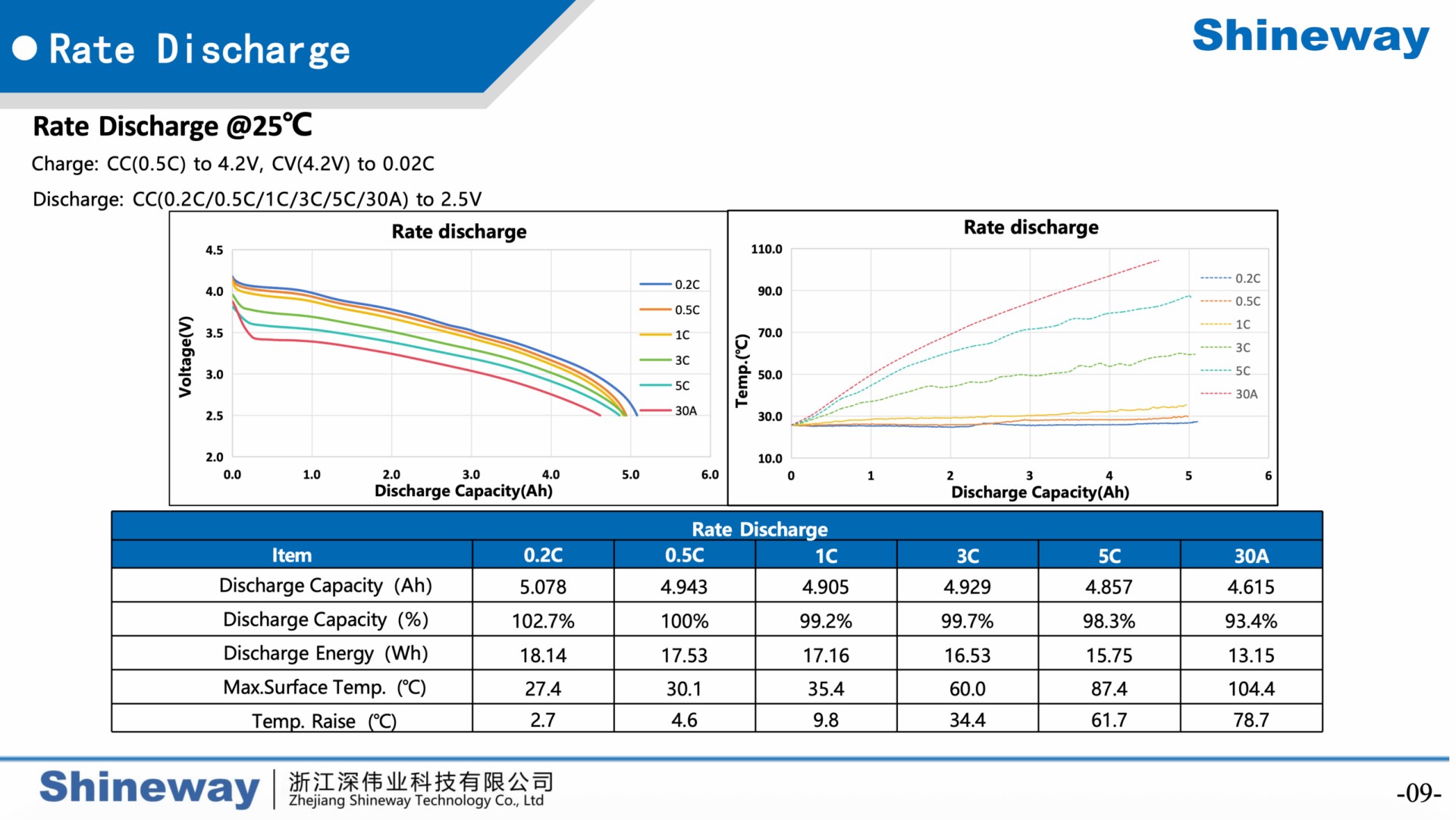
At 3C (15A) discharge rate we’re still getting 16.5Wh of energy and 60C maximum surface temperature. Since the maximum expected discharge rate is 2C or 10A per cell (see below), we should be able to get 16Wh of usable energy at ~50C surface temperature.
Battery Protection System (BMS)
The BMS board that came with the kit was one of the most popular implementations found on AliExpress which are built around the CellWise Microelectronics CC9053/CC1053 battery protection chips. It monitors the five series-connected cell groups (5S) and controls external power transistors (MOSFETs) which connect or disconnect the pack when a protection condition is detected. The external charger still has to regulate charging current and voltage.
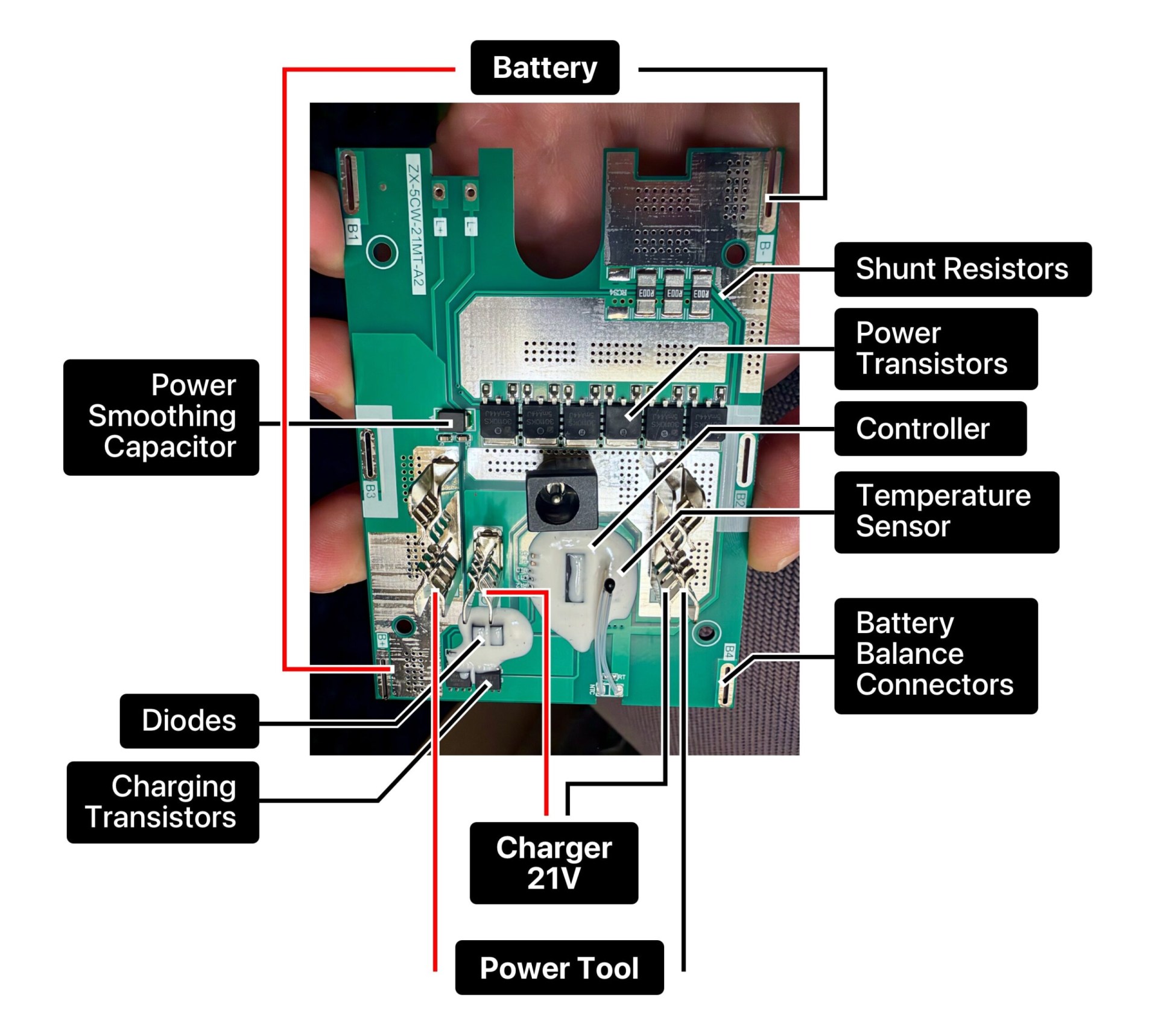
CW1053 provides overcharge, over-discharge, over-current, short-circuit and temperature protection. It does not support cell balancing and the exact protection thresholds (voltage, current, temperature) depend on the surrounding circuit.
To evaluate a board you should check the following:
- Discharge path: the components carrying current between the cells and the positive/negative power tool terminals. The board above has 7 power transistors on the output path followed by three shunt resistors.
- Charge path: the components carrying current between the charger terminal and the cell groups. This is usually a separate circuit with a much lower current limit (unfortunately). The board above has 2 parallel diodes followed by 2 smaller charging transistors.
- Balancing: whether the board can discharge individual high-voltage groups or only monitor them and stop charging. The board above doesn’t have any.
- Protection: the actual voltage, current and temperature thresholds usually configured through different resistor values (defined in datasheet).
Output Current and Power
The current required by the tool can be determined by dividing the maximum power output (such as 1kW in case of the trimmer) with the battery voltage which (in case of 2x18V packs) is 36V nominal:
1000W / 36V = 28ANote that with a fully charged or slightly discharged battery the current would be lower or higher. Accounting for additional heat losses in the motor and the power supply, we can estimate the required output to be 40A.
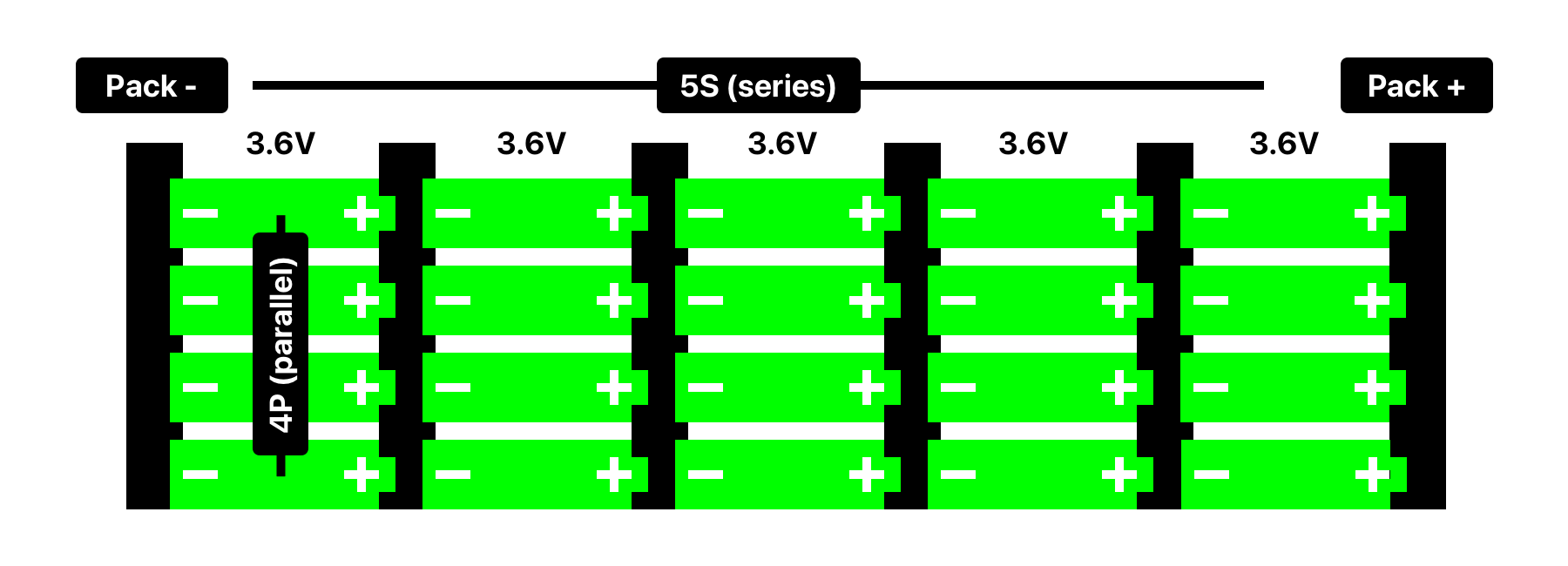
With two packs connected in series the current remains at 40A per pack. Since the packs have 5 cell groups in series, each of them must provide the same 40A. Each group contains 4 cells in parallel so each cell must provide 10A.
| Voltage | Current | Power | |
|---|---|---|---|
| One cell | 3.6V | 10A | 36W |
| One 4P cell group | 3.6V | 40A | 144W |
| One 5S4P pack | 18V | 40A | 720W |
| Two packs in series | 36V | 40A | 1440W |
The Shineway cells have a 5C rating for maximum continuous discharge which is 25A (5Cx5Ah nominal capacity) so doing 10A at peak should be OK.
As even extra large batteries on trimmer does not give too much of a working time, but add extra weight for hands, I am thinking of putting extra batteries in backpack. So what do you think of idea to add 3 to 5 kgs of batteries and make some kind of connector to trimmer like I saw from Huqvarna? Trimmer stays light, and you have extra power for longer jobs. And you can use it with other Makita tools if needed, like reciprocated saw – I use in demolition jobs and working on bushes.